
Syrian-Armenian Specialist Restores Rare Arabic Manuscripts at Yerevan’s Matenadaran
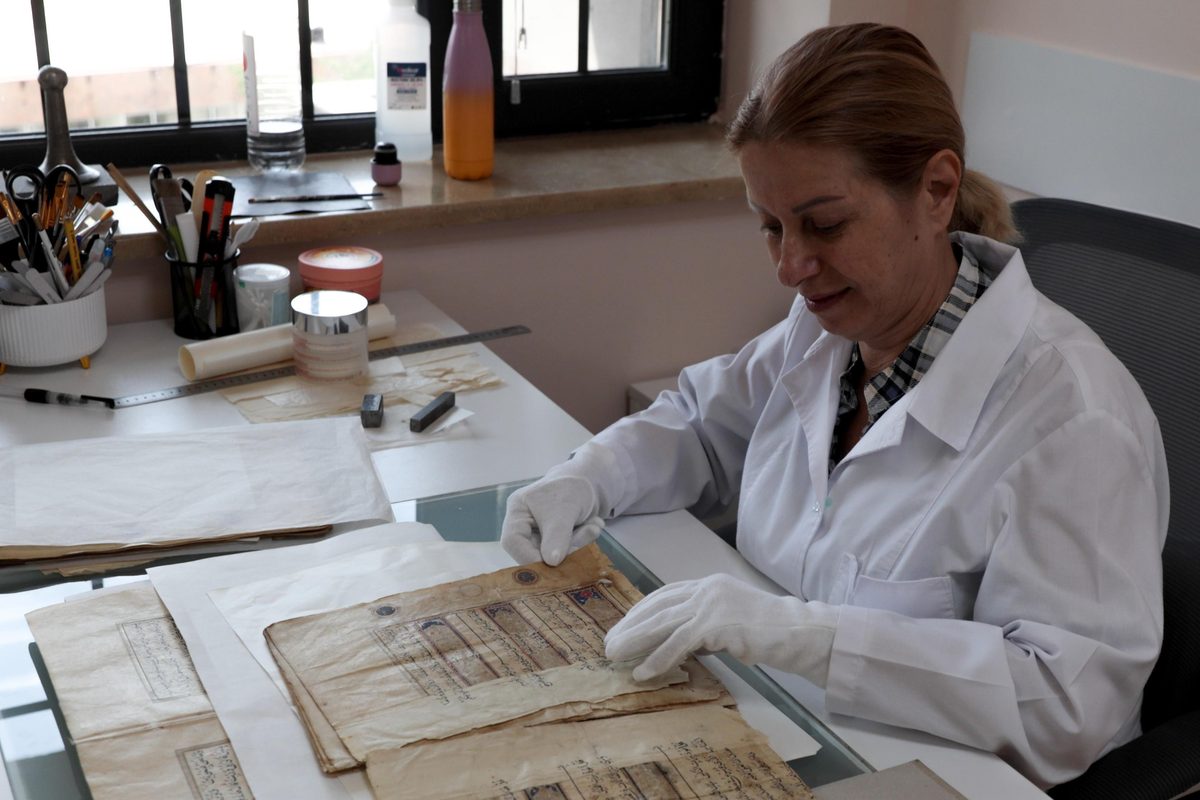
Karin Abelyan, a Syrian-Armenian specialist, is breathing new life into unique Arabic manuscripts at the Matenadaran—Armenia's central repository of ancient texts in Yerevan. Fleeing the war in Syria, she moved to Armenia in 2021 and now dedicates her expertise to preserving the region's rich cultural heritage.
The Matenadaran in Yerevan houses a vast collection of over 1,800 Arabic manuscripts, encompassing religious, literary, medical, and mathematical texts. Karin Abelyan, an expert in the restoration of Arabic manuscripts, works alongside her colleague Lusine Tumanyan to preserve this invaluable collection. Currently on her desk is a 17th-century Quran brought from Persia, which requires delicate page binding and extensive restoration.
Restoration Techniques and Historical Materials
Unlike many other manuscript traditions that heavily utilized blue, green, gold, and silver tones, traditional Arabic texts predominantly feature black and red inks. The black ink was typically derived from iron or charcoal, while the red was often crafted using Armenian cochineal (vordan karmir), a renowned crimson dye made from a scale insect endemic to the Ararat Valley and the Arax River basin. The use of this local dye in Arabic texts is a testament to historic cross-cultural trade. As Gayane Mkrtumyan, a researcher at the Faculty of Oriental Studies at Yerevan State University, pointed out to Hetq, it is impossible to understand the region's diverse cultures in isolation.
According to Abelyan, the 17th-century Quran underwent a flawed restoration in the 1960s using incorrect European methods. Iron-infused paper was used, which eventually caused the original pages to turn black. Furthermore, the previous restorer took the liberty of rewriting missing portions of the text.
"This contradicts international conventions, as it is historically incorrect," Abelyan explains, noting that modern restoration ethics prohibit her from altering or "correcting" that past mistake today.
Today, the restoration process utilizes high-quality Armenian-made paper, which rivals the standard of the Japanese paper that was historically imported for such delicate work.
Escaping the Syrian War and Relocating to Armenia
Abelyan has been working with Arabic manuscripts since 2004, having launched her career at the National Museum of Damascus. During the siege of Damascus in the mid-2010s, museum exhibits had to be urgently evacuated to safer locations. She recounts the harrowing story of how the director of Syria's Tadmor Museum saved a collection, smuggling it past terrorist checkpoints in a truck loaded with fallen soldiers.
The meticulous restoration process can take several months and consists of the following key stages:
- Preliminary cleaning of the manuscripts,
- Eliminating various physical and chemical defects in a laboratory setting,
- Detailed cataloging and description of each page by specialists,
- Paper stabilization and final digitization.
Due to the ongoing war and international sanctions in Syria, importing specialized Japanese paper became impossible. Faced with severe shortages, including a lack of gas and electricity, Abelyan and her family were forced to relocate to Yerevan in 2021, where she now continues her vital professional work at the Matenadaran.
This article was generated automatically using AI based on reporting from established news sources. All sources are listed below.
The essentials, no spam.